Does Crate Training Help With Anxiety?
If you think your dog may be anxious, it can be difficult to know what will actually help. You may have heard that crate training can make an anxious dog feel safer, but the answer isn't quite that straightforward.
A crate doesn't treat anxiety. For some dogs who already feel comfortable using one, a crate can provide a familiar place where they choose to rest or retreat. For others - particularly dogs who find confinement difficult or who become distressed when left alone - shutting them in a crate can actually increase their distress.
Whether a crate is helpful really depends on the individual dog, what is causing their anxiety and how they feel about being confined. In this article, I'll look at some of the signs your dog may be struggling, what can contribute to anxiety and when access to a crate might, or might not be helpful.
Signs of Anxiety in Dogs
When looking for signs that your dog is anxious, it's important to remember that every dog is different - two dogs in the same situation may show it in completely different ways.
Some Signs You Might Notice Include:
Ears back
Lip licking (when there’s no treat present)
Tail tucked between their legs
Excessive panting or barking
Drooling more than usual
Shaking
Hiding or shying away
Going to the toilet in the house
You May Also Notice Some More Subtle Signals:
Whale eye (when your dog turns their head away but keeps watching you, showing the whites of their eyes)
Turning away or leaning back
Yawning when they're not tired
Sudden stillness (where a dog who was moving freely stops and goes quiet)
It’s important not to look at any one of these signs in isolation. Lip licking, yawning or holding the ears back, for example, doesn't automatically mean that a dog is anxious.
I’m interested in the whole dog, what is happening around them and whether I’m seeing changes from what is normal for that individual dog.
Noticing these patterns can help you understand your dog better and can also give your vet or behaviourist useful information about when and where your dog may be struggling.
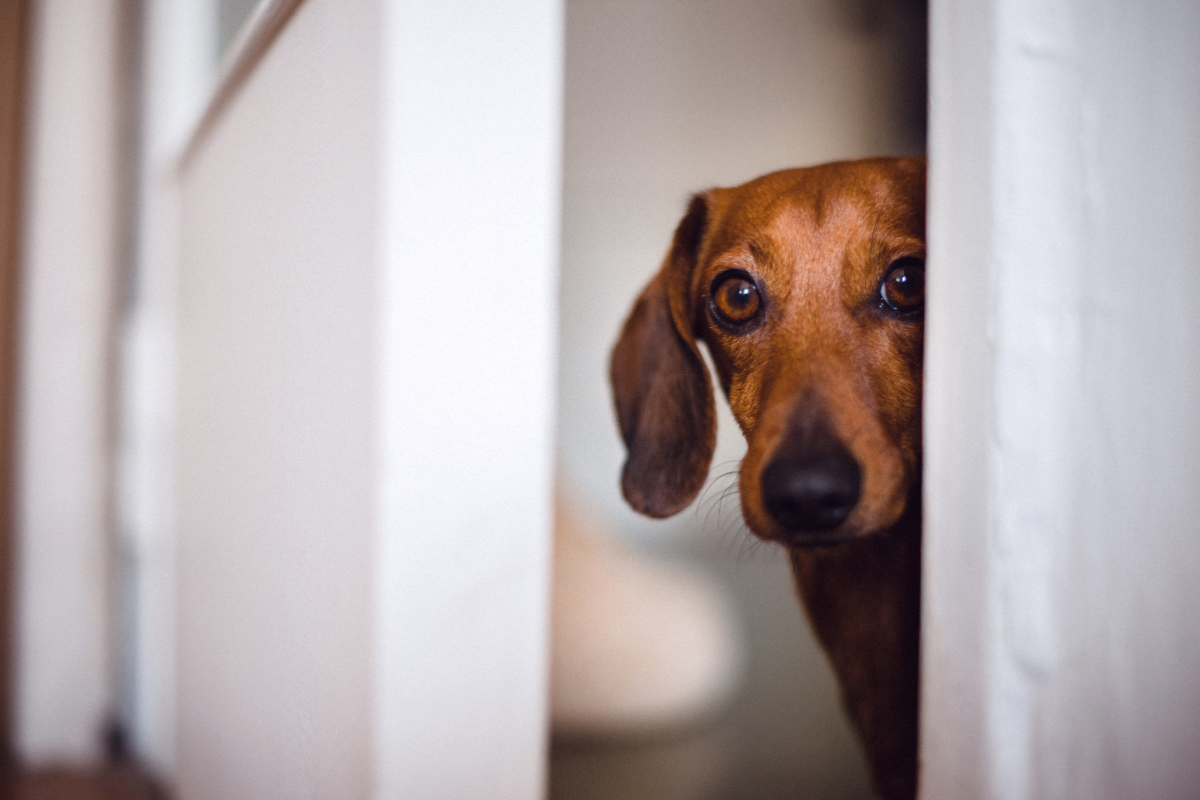
Dogs can show discomfort in many different ways. Looking at the whole dog and the context in which behaviour occurs can help us understand what they may be feeling.
What Causes Anxiety in Dogs?
There isn’t one single cause of anxiety in dogs. A dog may struggle for many different reasons, including previous experiences, separation-related distress, sensitivity to sounds or particular environments, changes within the home, social experiences and individual temperament.
We also need to consider pain and physical discomfort. Research by Mills et al. (2020) suggests that pain may be involved in a significant proportion of behaviour cases. Their review found that a conservative estimate was around a third of referred cases, with some referral caseloads reporting figures approaching 80%.
Sometimes the first thing we notice is a change in behaviour rather than an obvious sign of pain, so this is something I pay particular attention to in my own behaviour work.
My own dog Rosie is a good example. Changes in her behaviour were part of a much bigger picture that ultimately included spinal pain. Experiences like this, alongside what we know from the research, are why I think it’s so important not to look at behaviour in isolation.
If your dog’s behaviour has changed or you’re seeing something that seems out of character, speaking to your vet can be an important part of understanding what’s going on.
Crate Training: What Is It and Does It Help With Anxiety?
A crate can be introduced as a comfortable place for a puppy or dog to rest and sleep. Some dogs really enjoy using one and will choose to take themselves there when they want some downtime, while others may prefer to rest somewhere else.
When we're thinking about anxiety, there's an important difference between a dog choosing to use a crate because they feel comfortable there and using a crate as a way of managing an anxious dog.
A familiar crate may be a useful resting place for some dogs, but simply putting an anxious dog into a crate doesn't address why they're struggling. For a dog who finds confinement difficult, it may actually make things worse.
The most important thing is to look at the individual dog in front of us - how they feel about the crate, whether they are choosing to use it and what is driving the behaviour we're concerned about.
When Might a Crate Be Helpful?
If your dog already has a positive association with their crate and chooses to spend time there, having access to it can give them another familiar place to rest.
A crate may be useful as an optional resting space if your dog:
Chooses to go into it without being prompted
Shows relaxed body language while they are inside
Can enter and leave freely
Already has a positive association with the space
Comfortably rests or sleeps there
For example, a dog who already chooses to sleep in an open crate may decide to use it when the household becomes busier or they want some quiet time. If they choose to use it, that's fine. If they'd rather leave, they should be able to.
The important point is that the dog is choosing to use the crate because they already feel comfortable there. That's very different from putting an anxious dog into a crate in the hope that being confined will make them feel safer.
When a Crate Makes Anxiety Worse
For some dogs, being confined in a crate can itself be difficult. This may be because the crate hasn't been introduced gradually, because of previous experiences, or simply because that individual dog finds confinement stressful.
Signs that your dog may not be comfortable can include:
Reluctance to enter the crate
Barking, whining or howling
Panting or drooling
Repeatedly changing position or being unable to settle
Refusing food they would normally take
Scratching, biting or pushing at the crate
Attempts to escape
Not every dog will show their distress in an obvious way. Some dogs may become very still or withdrawn, so a dog being quiet in a crate doesn't necessarily mean that they're comfortable. Again, it's important to look at the whole dog and what is normal for them.
We need to be particularly careful when a dog struggles with being left alone. Separation-related distress and confinement distress are not the same thing, although a dog can experience both.
If a dog is already distressed about being left, shutting them in a crate doesn't address the reason they're struggling. If they also find confinement difficult, it can increase their distress and in some cases they may injure themselves trying to escape.
If your dog is showing signs of distress in a crate, I wouldn't simply keep repeating the experience in the hope that they'll eventually get used to it. We need to understand why they're finding it difficult and consider whether a crate is actually the right option for that dog.
What if My Dog Doesn’t Like Their Crate?
That's okay. A dog doesn't need to use a crate in order to feel safe or learn to settle.
Depending on your dog and your home, other options might include a comfortable bed in a quiet area, access to another room, a puppy pen or creating a larger dog-safe area. What matters is finding an arrangement in which your individual dog is genuinely comfortable, rather than feeling that every dog needs to learn to relax in a crate.
If you have a puppy and you're deciding how best to create a comfortable resting space, you can also read my guide to choosing between a crate and a puppy pen.
For rescue dogs, settling into a new home can also take time, particularly when we may know very little about their previous experiences. Giving them choice, predictability and somewhere they feel comfortable can be more helpful than assuming they need to use a particular type of resting space. You can read more about helping a rescue dog settle into their new home.
Vivienne Moore is an Accredited Canine Behaviourist and Trainer dedicated to helping dogs and their families across Norfolk.
When to Get Professional Help for Anxious Dogs
If you've noticed changes in your dog's behaviour or you're concerned that they may be anxious, I recommend speaking to your vet first. This is particularly important where behaviour has changed or seems out of character, as pain, discomfort or another medical issue may be contributing.
Behaviour support can then help us look more closely at what your dog is experiencing, when the behaviour occurs and what might be making those situations difficult for them.
During a Behaviour Consultation, I look at the whole dog, including their behaviour, environment, experiences and physical wellbeing, rather than simply focusing on the behaviour you want to change. From there, we can put together a practical, individual plan to support both you and your dog.
I’m an Accredited and Certified Dog Behaviourist and Trainer with over 14 years' experience, and I specialise in supporting dogs experiencing anxiety, fear and other behaviour difficulties using a compassionate, evidence-based approach.
You don’t need to have everything figured out - all you need to do is tell me a little about your dog and I’ll guide you on what to do next.
