Why Does My Puppy Sit Down on Walks?
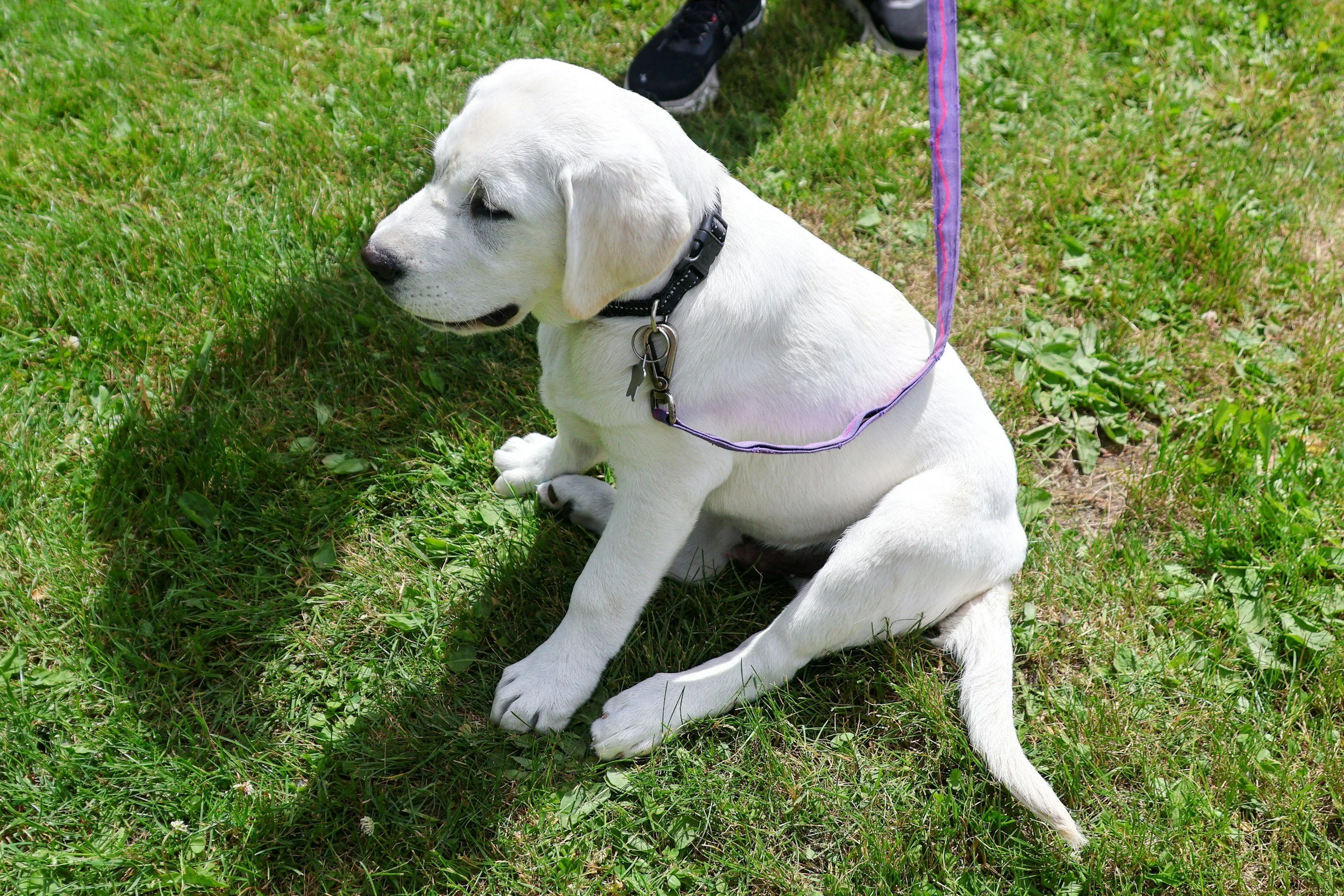
You take your puppy out for a walk and after a few minutes they sit down. You call them, encourage them to come with you or perhaps get a treat out to persuade them to start moving again. Sometimes owners may even pull or give a little tug on the lead. They walk a little further and then stop again.
It’s something I hear about quite often from puppy owners. Why does my puppy keep stopping? Why won’t they walk? Are they just being stubborn?
Before thinking about how to get them moving again, I think it’s much more useful to ask why they have stopped in the first place. There can be several reasons. They may be tired or overwhelmed, something may have worried them, or they may simply need a little more time to take in what is happening around them. As owners, we can sometimes be in too much of a hurry to get them moving again.
Your puppy may be tired
Being out in the world can be tiring for a puppy in ways that have very little to do with how far they have actually walked. Your puppy may be sniffing, watching people, hearing traffic, noticing other dogs and encountering things they haven’t experienced before. It’s also worth thinking about what else has happened that day. Have you had visitors? Have they been somewhere new, had a trip in the car, met new people or experienced something unfamiliar?
What seems like a fairly ordinary day to us can involve a lot of new information for a young puppy, and sometimes sitting down may simply mean they need a break.

Being out in the world can be tiring for a young puppy, even when they haven't walked very far. There's so much to take in.
They may be feeling overwhelmed
Stopping can also be a sign that your puppy is finding something difficult. Perhaps a dog has appeared ahead, there’s traffic nearby, children are playing or something unfamiliar has made a noise. Sometimes there may simply be too much happening at once.
This is where I want to look at the whole puppy rather than just the fact that they have stopped. Are they relaxed and watching or are they very still and tense? What are their ears, face and tail doing? Are they able to sniff and look around, or are they completely focused on one thing? Can they look away from whatever has caught their attention?
A puppy who is overwhelmed doesn’t necessarily need encouragement to keep going. They may need more distance, a quieter environment or perhaps they have simply had enough for that day.
Sometimes they need time to take things in
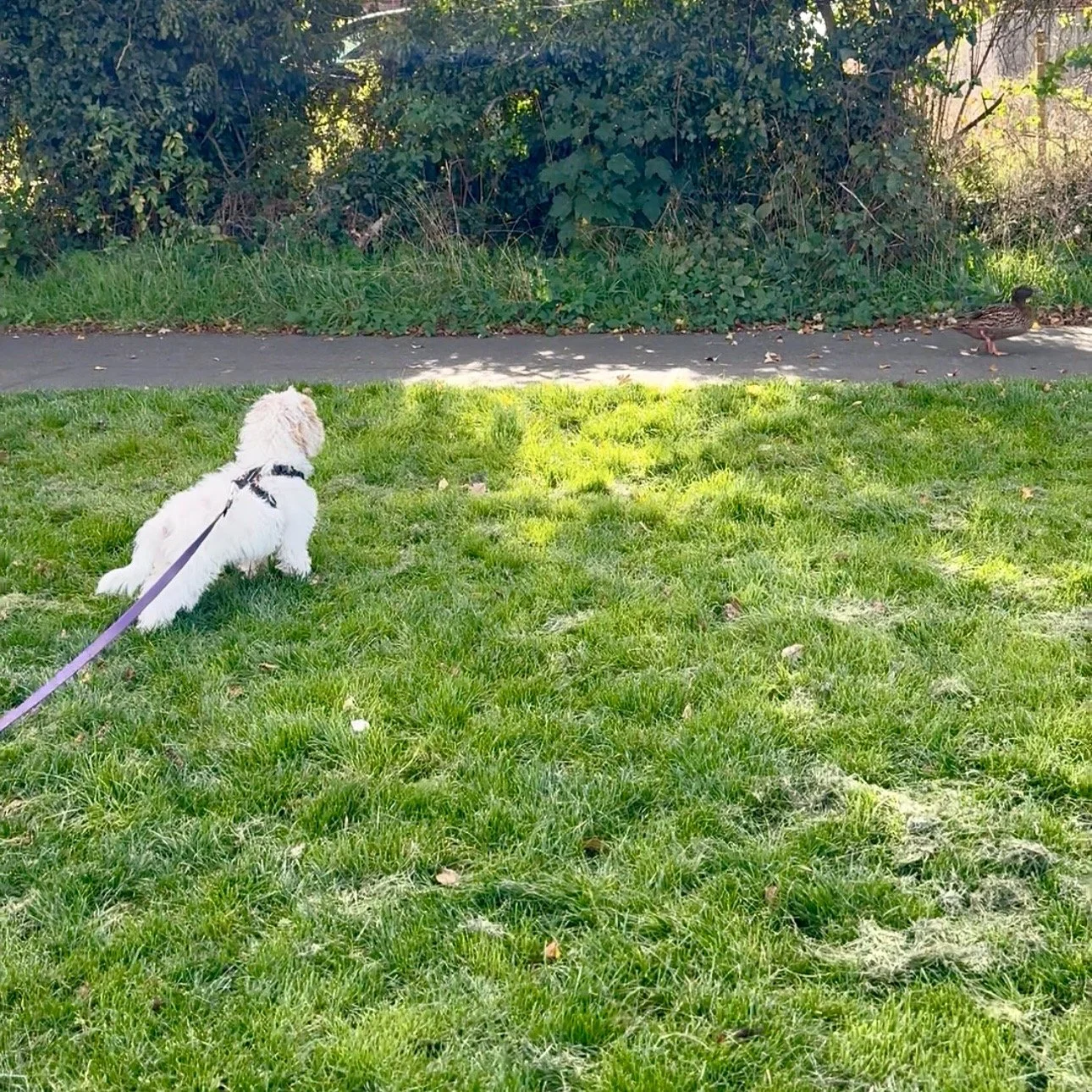
Sometimes a puppy just needs a moment to stop, watch and take in what's happening around them. Here, a passing duck has caught this puppy's attention. There's no need to hurry him along.
This is something I see a lot. A puppy stops, sits down and watches what is happening around them. To us, it can look as though they’re doing nothing, but the world is still very new to a young puppy.
Someone getting out of a car, a dog walking on the other side of the road, a child on a scooter or an unfamiliar noise behind a fence may all be worth stopping for. We can be surprisingly uncomfortable with that pause. We are on a walk, so we feel as though we should be walking. We call the puppy, encourage them, put a little tension on the lead or get some food out to persuade them to carry on.
Quite often, we don’t need to do anything immediately.
If I'm with a puppy who has stopped, I'll often give them some time and see what happens next. They might watch for a few seconds before carrying on, start sniffing or decide they'd rather move away from whatever has caught their attention. All of those choices give me useful information about how that puppy is experiencing the environment.
Research into animal welfare has increasingly considered the importance of choice and control. A 2023 review by Englund and Cronin looked at the role of choice and control in animal welfare and the opportunities animals have to exercise agency in their environment. Obviously, this doesn’t mean our puppies can make every decision about their lives, but I do think there is value in giving them opportunities to make appropriate choices. If we immediately intervene every time a puppy pauses, we may never find out what they would have chosen to do.
Try not to pull your puppy forwards
There is another pattern I often see when a puppy stops on a walk. The puppy sits down and their owner carries on until they reach the end of the lead. They turn around, face the puppy and start encouraging them forwards. If the puppy still doesn’t move, there can be a temptation to put pressure on the lead or give a little tug to get them going. I really don’t like using the lead in this way.
If we go back to the question of why the puppy stopped, think about how that might feel from their point of view. They may have stopped because something has caught their attention, because they’re unsure about what is ahead, because they’re overwhelmed or simply because they need a moment. They don’t understand that we’ve decided to complete a particular route or that we think they should keep walking.
Now, on top of whatever caused them to stop, they feel pressure through the lead asking them to move forwards. For a puppy who is already unsure, that can add even more pressure to the situation. Some puppies will brace against it or pull backwards, and we can very quickly find ourselves in a battle over moving forwards when we still haven’t worked out why the puppy stopped.
It’s also worth thinking about what we’re trying to teach our puppy about the lead. Most of us want our puppies to learn to walk without pulling and to understand that a loose lead is what allows us to move together. If we then use tension on the lead to pull them in the direction we want to go, we’re not being particularly consistent. If we want our puppy to learn not to pull us around, it makes sense that we shouldn’t pull them around either. Instead, move back towards your puppy and let the lead soften. You might stand alongside them and look at what they are looking at rather than standing in front of them asking them to come towards you. See what happens when that pressure has gone. They may start sniffing, get up and carry on by themselves or choose a slightly different direction. Their body language may also tell you that they would rather move away from whatever is ahead. If you do need to encourage movement, I would much rather make it easy for the puppy to move with you than pull them into a situation they are hesitating about.
The lead is there to keep your puppy safe, not to physically make them move forwards. Taking the tension out of it gives you a much better opportunity to understand why they stopped in the first place.
Do I need to use treats to keep my puppy walking?
Food is incredibly useful in puppy training and I use it regularly, but there is a difference between using food to help a puppy learn and automatically reaching for a treat every time they stop.
If your puppy has paused because they are taking something in, putting food under their nose and luring them onwards may interrupt that opportunity. If they're tired, worried or overwhelmed, using food to encourage them forwards may get them moving, but that doesn't mean they're feeling any more comfortable. They may simply be following the food despite their hesitation. It can be very easy to think the treat has worked because the puppy is walking again. I’m more interested in understanding what caused them to stop.
Giving them a few seconds before reaching for food can tell you quite a lot.
Not every moment needs to be a training exercise
There can be enormous pressure when you bring home a puppy to get everything right. We think about loose lead walking, recall, focus, settling, handling and all the other skills we want them to learn. At the same time, we’re told how important socialisation is and how much puppies need to experience while they’re young.
It’s very easy for every outing to turn into another training session. Puppies also need time simply to experience the world. Sniffing, watching and exploring aren’t wasted minutes between training exercises.
There is some interesting research around this. In a 2019 study, Duranton and Horowitz compared pet dogs taking part in nosework with dogs doing heelwork. The dogs in the nosework group subsequently showed a more positive judgement bias. The researchers discussed both the opportunity to use olfaction and the greater autonomy involved in nosework as possible factors. This was a relatively small study involving adult dogs undertaking a particular activity, so we shouldn’t assume that it tells us exactly what happens when a puppy sniffs on a walk. It does, however, offer an interesting perspective on the potential value of allowing dogs opportunities to use their noses and make choices about what they do.
Training is important, but it is only one part of raising a puppy. Giving them time to sniff, explore and observe also gives us an opportunity to learn about them. We can see what they notice, what they are curious about, what makes them hesitate and when they would prefer a little more space. If we are constantly asking our puppy to do something, it can be very easy to miss what they are telling us.
Forget the route and go for a mooch
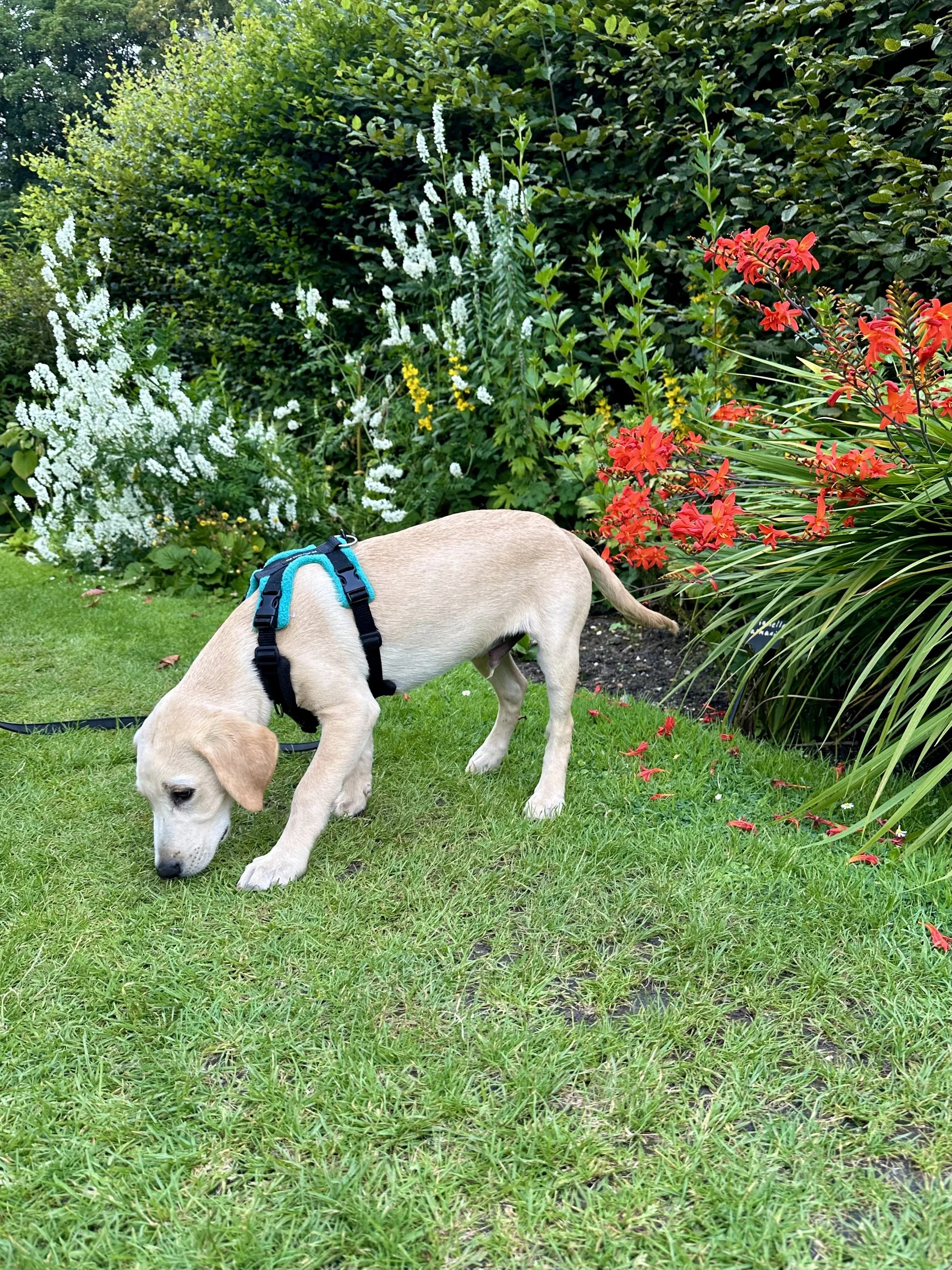
Sometimes a good puppy walk is simply about having time to sniff, explore and investigate the world at their own pace.
We often set off on a dog walk with a particular route in mind. That can put us under unnecessary pressure when we are walking a puppy because, once we have decided we are going around the block or across the park, every time the puppy stops becomes an interruption to our plan. I much prefer the idea of giving yourself some time and going for a mooch.
Let your puppy sniff and explore. If they want to spend a couple of minutes investigating a patch of grass, that’s fine. If they stop to watch something happening across the road, give them a little time to do that. You may not get very far, but that doesn’t mean it wasn’t a worthwhile outing!
There are lots of rules repeated about exactly how many minutes a puppy should be walked according to their age. I don’t think we need to become too fixated on achieving a particular number or distance. Puppies are individuals, and the type of activity and the whole experience matter too. A short outing spent sniffing, exploring and observing can give a young puppy plenty to do without us needing to complete a predetermined route. It also means that when they do stop, we don’t have to be quite so concerned about getting them moving again because we have somewhere we think we need to get to.
Learning to do nothing
One of the things owners often tell me they would like their dog to be able to do is settle calmly in different environments. They would like to sit outside a café, stop for a chat, sit on a park bench or take their dog somewhere new without needing to constantly occupy them. Sometimes, though, we make being out in the world very busy for our puppies. We are asking for behaviours, rewarding them, offering them something to do or trying to keep their attention on us.
There is value in puppies discovering that sometimes nothing much happens.
Research into free-ranging dogs gives us an interesting comparison. When dogs have more choice about how they spend their time, they don’t spend all day walking around or looking for something to do. Resting and simply watching what is happening around them are a normal part of their day. Of course, our pet puppies live very different lives, but I think it’s worth considering how much of their time we try to fill. We walk them, train them, play with them and give them things to do, often with the very best intentions. Sometimes it’s okay for a puppy to simply sit and watch the world for a while.
For a young puppy, learning to simply be somewhere might start with sitting together on a quiet park bench for a few minutes. Give them time to look around, sniff the air, listen and watch what is happening at a comfortable distance. You don’t necessarily need to ask them to lie down or continually reward them for staying still.
If they eventually feel comfortable enough to lie down, that’s lovely. They may simply sit and watch, and that’s fine too. The aim isn’t to manufacture a perfect settle; we are giving them an opportunity to experience being somewhere without constantly having something expected of them.
Of course, we need to choose the environment carefully. A busy café surrounded by people and dogs may be far too much for a puppy who isn’t yet comfortable sitting on a quiet park bench. Start somewhere they can cope and build gradually.
Socialisation doesn’t mean constantly doing more
Good puppy socialisation isn’t about squeezing as many experiences as possible into the first few months of a puppy’s life.
We can become very focused on more dogs, more people, more places and more experiences, but more isn’t automatically better. The quality of those experiences matters. Sometimes watching a dog from a comfortable distance may be more appropriate than going over to meet them. Sitting on a bench and watching people go past can be an experience in itself, as can spending some time sniffing around the edge of a park.
We want puppies to experience the world in ways they can cope with, and sometimes that means doing less, slowing things down and giving them more time.
So what should I do when my puppy sits down?
Rather than immediately trying to get them moving, give them a moment and look at the puppy in front of you. Could they be tired? Has it been a particularly busy day? Is there something happening that they may be unsure about? Do they look tense or worried, or are they calmly sitting and watching something?
It’s worth looking at the environment too. Puppies often notice things before we do, so try to work out what has changed or what may have caught their attention. Then see what happens when you give them a little time. Sometimes they will get up and carry on without any help from us. Sometimes their body language will tell us that they need more space, or they may choose to move in a different direction. Sometimes they may simply have had enough for that day.
One last thing: could your puppy be uncomfortable?
Most of this article has been about the many perfectly understandable reasons a puppy might stop on a walk, but there is one other possibility I don’t want to overlook. If your puppy regularly stops or sits down on walks, particularly if this is new or becoming more frequent, I would also consider whether they could be uncomfortable.
Pain or discomfort doesn’t always look obvious. A puppy doesn’t have to be limping or crying for something physical to affect how willing they are to move. You might notice that they are slower than usual, reluctant to walk in a particular direction, sitting down more often, moving differently, struggling with certain surfaces or simply seeming less keen to keep going.
That doesn’t mean every puppy who sits down on a walk is in pain, but I wouldn’t repeatedly coax or pull a reluctant puppy forwards without considering whether there could be a physical reason for that reluctance. If there has been a change in your puppy’s behaviour or movement, or you have any concerns about how comfortable they are, speak to your vet. It’s much better to explore a possible physical reason than assume a puppy who doesn’t want to walk simply needs more training.
Slow things down
When a puppy repeatedly sits down on walks, it is understandable that our first thought is how to get them moving again. Sometimes, though, changing the question from “How do I make my puppy walk?” to “Why has my puppy stopped?” tells us much more.
Give them time to sniff, watch and take things in. Pay attention to what they do when there is no pressure from you to move, and don’t worry too much if your puppy walk doesn’t cover very much ground. Sometimes slowing ourselves down is one of the best ways to understand the puppy at the other end of the lead.
If you’re finding walks difficult with your puppy, or you’re not sure whether what you’re seeing is normal puppy behaviour or something they need more support with, I offer individual puppy training and support tailored to you and your puppy. The next time your puppy sits down on a walk, rather than immediately encouraging them to carry on, take a moment to consider what they might be telling you. Sometimes the most helpful thing we can do is simply give them a little time.
Puppy training and support in Norfolk
Whether you're looking for guidance with a new puppy, want to better understand their behaviour or need support with something you're finding difficult, I offer individual puppy training and support across Norfolk.
My approach focuses on understanding your puppy as an individual, supporting their emotional wellbeing and helping you build a positive relationship from the start.
You're welcome to get in touch through my Tell Me About Your Puppy form to find out how I can help.
References
Banerjee, A. & Bhadra, A. (2022). Time-activity budget of urban-adapted free-ranging dogs. Acta Ethologica, 25, 33–42. DOI: 10.1007/s10211-021-00379-6.
Duranton, C. & Horowitz, A. (2019). Let me sniff! Nosework induces positive judgment bias in pet dogs. Applied Animal Behaviour Science, 211, 61–66. DOI: 10.1016/j.applanim.2018.12.009.
Englund, M.D. & Cronin, K.A. (2023). Choice, control, and animal welfare: definitions and essential inquiries to advance animal welfare science. Frontiers in Veterinary Science, 10, 1250251. DOI: 10.3389/fvets.2023.1250251.
About the Author
Vivienne Moore ACB-KSA, PCT-A
Accredited Canine Behaviourist & Trainer
Vivienne is the founder of Walkies Dog Behaviour & Training, based in Norfolk. She specialises in working with dogs experiencing reactivity, fear, anxiety and other behavioural difficulties.
Her approach combines behavioural science with practical, individualised support, taking into account each dog's emotional and physical wellbeing.
